
Oversized Equipment Transport Without Blowing Your Schedule or Budget
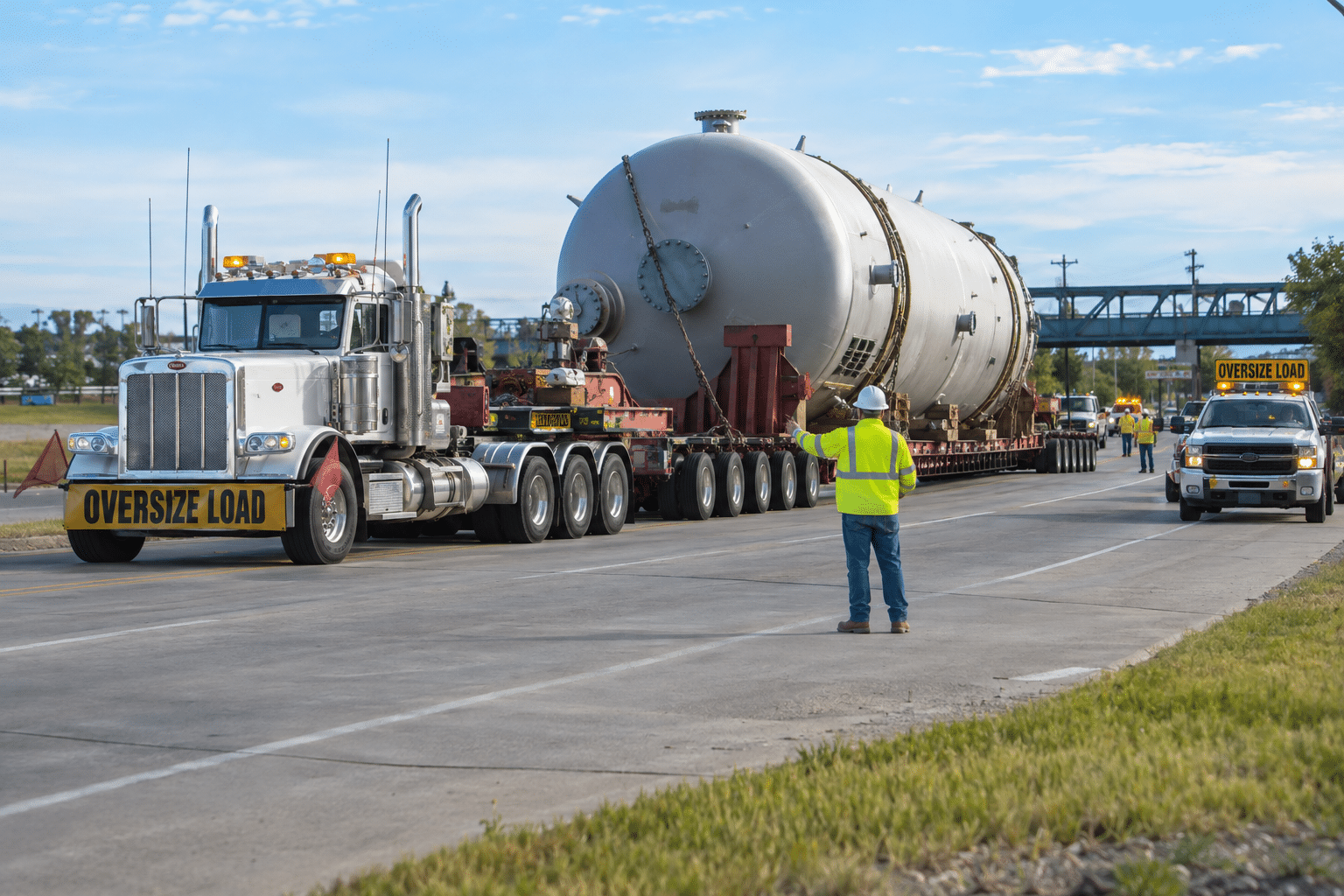
Oversized equipment transport is the process of moving industrial components that exceed standard legal limits for width, height, length, or weight on public roads. For Ohio Valley contractors working on manufacturing plants, chemical processing facilities, power installations, and infrastructure projects, this category can include crystallizers, reactors, large presses, generators, boilers, modular process skids, and similar heavy equipment that cannot move like ordinary freight.
The Thacker Pass lithium crystallizer superload campaign offers a current example of what that planning looks like at scale. As reported by Construction Executive, crystallizer components fabricated by Great Basin Industrial in Plymouth, Utah, are being transported roughly 600 miles to the Thacker Pass project in Nevada. Lithium Americas said on August 17, 2026, that a dozen superloads would begin that nearly 600-mile trek after more than a year of transportation planning.
This article uses that campaign as a practical anchor, then translates the same planning discipline into a contractor-facing playbook for industrial projects in the Ohio Valley. The core question is simple: how do you plan oversized equipment transport so it does not create safety hazards, public disruption, or commissioning delays that push your job off schedule?
What the Thacker Pass Superloads Show About Oversized Equipment Transport
If your team has ever tried to coordinate a heavy-haul move in the final weeks before startup, you already know the problem: specialized transport is often treated too late, even though the delivery of one critical component can drive the entire project sequence.
That is why the Thacker Pass crystallizer move matters beyond Nevada. The campaign shows that oversized equipment transport is not just a trucking task. It is a project-controls issue that starts well before fabrication is complete and reaches into routing, permitting, escorts, staging, crane planning, jobsite readiness, and owner communication.
For Ohio Valley contractors, the regional details will differ, but the planning logic does not. A move into Cincinnati, Dayton, Springfield, Lima, Northern Kentucky, or Southeastern Indiana may involve different roads, agencies, and site constraints than a Utah-to-Nevada superload, yet the same core discipline applies: define the load early, study the route, secure approvals, align field operations, and build the move into the master schedule.
Why Oversized Equipment Transport Is Really a Project-Control Decision
When a large reactor vessel, generator, modular skid, or crystallizer section sits on the critical path to commissioning, manage its delivery like a project milestone, not an afterthought. The transport plan affects fabrication release dates, route approvals, crane mobilization, rigging sequences, field access, and startup timing.
What Early Planning Protects
- Schedule certainty. Lithium Americas said the Thacker Pass crystallizer campaign followed more than a year of transportation planning. That is a useful reminder that complex heavy-haul moves often require long lead times, especially when multiple jurisdictions, escorts, staging points, or route reviews are involved.
- Budget control. Early route studies and coordination do not eliminate cost, but they reduce the odds of last-minute changes, standby time, and rushed field adjustments when a load arrives before the site is ready.
- Jobsite safety. Delivery planning has to connect with offload areas, exclusion zones, rigging plans, crew communication, and traffic management around the site.
- Regulatory readiness. Oversize and overweight moves can trigger permit reviews, routing conditions, travel restrictions, escorts, and utility coordination. Those requirements vary by state and route, so contractors should confirm them early with the carrier and the relevant agencies.
- Public and owner confidence. Large moves attract attention. Advance communication with stakeholders can reduce disruption and help owners understand that the delivery is being managed as part of the project plan rather than improvised at the last minute.
How Oversized Equipment Transport Works on a Superload Campaign
The Thacker Pass move provides a concrete example of what oversized equipment transport planning looks like on a major industrial project. Lithium Americas said on August 17, 2026, that 12 crystallizer superloads would begin a nearly 600-mile trip from Plymouth, Utah, to Thacker Pass after more than a year of planning.
While the geography differs from the Ohio Valley, the planning fundamentals are the same for any large industrial move: route constraints, escorts, weather exposure, travel restrictions, staging, and jobsite readiness all have to line up.
Step 1: Define the Load Precisely
Planning starts with reliable information from the fabricator: transport dimensions, gross weight, center of gravity, support points, and any handling or protection requirements. The transport team also needs to understand how the component will sit on the trailer and what that means for clearances, turning, and offload planning.
This is one of the clearest lessons from the crystallizer campaign. If a component is unusually wide, tall, heavy, or sensitive, those realities shape the route and the equipment configuration from the beginning. Waiting until fabrication is complete to start that conversation leaves very little room to solve avoidable problems.
Step 2: Study and Verify the Route
Heavy-haul planning requires route analysis for roadway geometry, clearances, bridge restrictions, grades, staging opportunities, and other physical constraints. Lithium Americas said the Thacker Pass campaign closed out more than a year of transportation planning before the superloads began moving.
For Ohio Valley contractors, the exact obstacles will depend on the project location. An urban delivery may raise turning, congestion, or access issues. A rural plant site may raise concerns about entrance roads, shoulders, temporary access, or laydown space. The key is not to assume the route works because it looks reasonable on a map. Oversized equipment transport needs an engineered and field-checked path.
Step 3: Secure Permits, Escorts, and Timing
Oversized loads often require permits and may require escorts or other route-specific controls, depending on the load and jurisdiction. Contractors should expect approval timing and travel windows to vary by route and by state.
The Thacker Pass campaign shows why timing matters. It was publicly framed as a coordinated series of superloads, not a one-off shipment, which means staging, travel windows, and sequence all had to be managed as part of a broader operation. On any industrial project, treat those external approvals as schedule dependencies, not assumptions.
Step 4: Align the Move With Jobsite Readiness
The route can be fully approved, and the carrier can still arrive at a site that is not ready. That is where oversized equipment transport becomes a field-coordination issue. Gate access, laydown areas, temporary roads, crane pads, lift sequencing, and rigging crew availability all need to be confirmed before the load shows up.
A transport plan succeeds when the carrier, superintendent, rigging team, and project manager are all working from the same sequence. If the equipment arrives before foundations, access routes, or crane setups are ready, the project pays for the mismatch.
What a Strong Oversized Equipment Transport Plan Should Include
A useful plan is specific, assigned, and tied to the master schedule. It should not live only in a carrier email thread or a late procurement conversation.
Planning Fundamentals
- Master-schedule milestones. Include fabrication release, shipping readiness, permit submissions, route confirmation, delivery window, offload, and set-in-place activities in the project schedule.
- Defined responsibilities. Clarify who owns transport coordination on the contractor side, what the carrier is responsible for, what the rigging contractor needs to know, and how to escalate issues.
- Route and approval tracking. Keep a simple matrix showing route status, permit status, escorts or agency coordination, and any unresolved constraints.
- Trailer and handling alignment. Confirm that the trailer configuration, support method, and offload plan fit both the load and the site conditions.
- Risk-register visibility. Add the move to the project risk log, with triggers for delays, route changes, weather disruptions, or site-readiness issues.
Safety and Public Interface
- Traffic and access planning. Identify how the move interacts with site entry points, nearby roads, employees, other trades, and the public.
- Lift and offload planning. Use dedicated pre-task planning, job hazard analysis, and lift coordination for the delivery and set.
- Stakeholder communication. Notify the owner, field leaders, and any affected parties early enough that the move does not come as a surprise.
Commercial Alignment
- Contract clarity. Spell out who carries responsibility for transport coordination, route changes, standby exposure, escorts, delays, and damage in transit.
- Insurance review. Make sure the relevant cargo, builder’s risk, and site-liability questions are addressed before releasing the shipment.
- Change-management triggers. Establish in advance what happens if permits shift, the route changes, or the site cannot receive the load on the planned date.
How Oversized Equipment Transport Affects the Jobsite
A permitted route does not guarantee a smooth delivery. The field team still has to receive, protect, and install the equipment safely and efficiently.
Staging and Access
Large industrial components need planned laydown space, adequate bearing capacity, and room to maneuver. On greenfield or developing industrial sites, that may require temporary access improvements or sequencing changes so the transport can reach the final receiving point.
Cranes, Rigging, and Crew Readiness
Heavy-haul arrival windows need to match crane availability, rigging plans, and crew assignments. Discuss the delivery sequence in advance, including communication protocols between the driver, escorts, rigging lead, and site supervision.
Protecting the Equipment
Sensitive equipment can be damaged by poor staging, unnecessary handling, weather exposure, or interference from other trades. The receiving plan should address where the component will sit, how it will be supported, who controls the area, and when it will be set in place.
What Ohio Valley Contractors Can Learn From the Crystallizer Superloads
The Thacker Pass campaign is useful because it makes visible a part of project delivery that often stays buried until something goes wrong. The headline is not just that large crystallizers are moving hundreds of miles. It is that those moves required advance planning, public coordination, and a transportation strategy integrated with project execution.
Lesson 1: Start Earlier Than Feels Necessary
If a load is likely to require special routing or approvals, start planning during preconstruction or early procurement. The more critical the equipment is to commissioning, the less sense it makes to delay logistics planning.
Lesson 2: Treat Transport as a Multi-Party Coordination Problem
Fabricators, carriers, escorts, agencies, utilities, rigging teams, and field leadership may all influence the move. Someone on the contractor side needs to keep those threads connected.
Lesson 3: Pressure-Test the Schedule
Check owner milestone dates against transport reality. If a piece of long-lead equipment sits on the critical path, the delivery window needs to reflect actual route work, permit timing, and site readiness, not just the desired startup date.
Lesson 4: Use Specialized Partners Early
Superloads and heavy industrial moves are specialized work. Contractors benefit from bringing in experienced heavy-haul, rigging, and lifting partners before locking in decisions.
A Practical Oversized Equipment Transport Checklist for Industrial Projects
Use this checklist to strengthen internal planning on projects involving oversized or overweight equipment.
During Preconstruction and Procurement
- Identify which components are likely to require oversized equipment transport.
- Capture preliminary dimensions, weights, and handling constraints from the fabricator.
- Select transport and rigging partners early enough to influence route and site planning.
- Add delivery planning to the baseline schedule and project risk register.
Before Shipment
- Confirm the proposed route and the status of any required permits or agency coordination.
- Hold a coordination meeting with the carrier, rigging team, superintendent, project manager, and owner representative if needed.
- Verify on-site receiving conditions, including access paths, laydown areas, crane pads, and weather-sensitive work areas.
- Confirm contractual responsibility for delays, damage, and transport-related changes.
Shortly Before Delivery
- Update final dimensions and transport configuration if anything changed during fabrication.
- Finalize the delivery sequence, offload plan, and field communication protocol.
- Distribute logistics and safety information to field leadership and affected trades.
- Confirm crane, rigging, and exclusion-zone readiness.
Move Day
- Check route and site conditions, including weather and access changes.
- Assign one on-site point of contact for real-time communication with the carrier.
- Keep the receiving area controlled and clear.
- Document lessons learned after the move for future projects.
Who Should Own Oversized Equipment Transport Inside the Company
Heavy-haul success usually depends on one simple thing: clear ownership. Assuming the carrier will manage every issue leaves gaps between transportation planning and jobsite execution.
Executives and Preconstruction Leaders
- Set expectations that oversized equipment transport belongs in proposals, procurement planning, and risk reviews when critical equipment is involved.
- Make sure transport complexity is reflected in schedule logic and commercial assumptions.
Project Managers and Superintendents
- Coordinate with carriers, rigging partners, and the owner’s team.
- Integrate delivery milestones into look-ahead planning.
- Lead field readiness for access, receiving, safety, and sequencing.
Safety and Training Leaders
- Support planning for JSAs, lift coordination, traffic control, and public-interface risk.
- Use complex deliveries as training opportunities for crews and supervisors working around heavy equipment movements.
- Where appropriate, connect process improvement to broader safety benchmarking tools such as STEP.
Oversized Equipment Transport FAQ for Industrial Projects
These questions come up regularly when contractors are planning the movement of large industrial components.
What qualifies as oversized equipment transport?
In general, it refers to moving equipment that exceeds ordinary legal road limits for size or weight and therefore needs specialized equipment, route review, permits, or other controls.
When should planning begin?
Planning should begin as soon as preliminary dimensions and critical-path importance are known. The Thacker Pass crystallizer campaign is a useful reminder that major moves may require more than a year of preparation.
Who handles permits and escorts?
Carriers often manage permit applications and escort coordination, but the contractor still needs visibility into timing, conditions, and schedule risk. Define those responsibilities in writing.
How do contractors reduce risk on a heavy-haul move?
Start early, confirm the route, tie the move to the project schedule, and make sure the site can actually receive the load when it arrives.
Do crews need special preparation?
Crews involved in receiving, rigging, signaling, or traffic-interface work should have task-specific planning and role-appropriate training.
Get Your Next Oversized Equipment Transport Move Right
Oversized equipment transport is a project-controls issue, not a commodity shipping task. Route work, approvals, delivery sequence, site access, crane readiness, and offload planning all affect cost, safety, and commissioning.
The Thacker Pass crystallizer superloads show what that looks like in practice: a dozen superloads, a nearly 600-mile route, and more than a year of transportation planning before the move began on August 17, 2026. Ohio Valley contractors may be working on a smaller geographic scale, but the same principle applies. If one critical piece of equipment can move your startup date, its transport plan belongs in preconstruction, procurement, and field coordination from the start.
ABC Ohio Valley supports the workforce development, apprenticeship, and safety education that help contractors handle complex industrial work across the region. Contractors looking to strengthen field capability for rigging-adjacent trades and industrial project execution can review the chapter’s apprenticeship pathways and safety resources to build the planning discipline these moves require.