
Key Takeaways
- On November 3, 2026, Trenton, Ohio voters will decide Issue 17, a citizen-initiated charter amendment that would prohibit any new data center in the city with aggregate monthly demand or peak load above 25 megawatts.
- The Ohio Supreme Court unanimously ordered Issue 17 onto the ballot on September 1, 2026, after residents submitted 336 valid signatures-well above the 128 required under the state constitution.
- A “yes” vote would bar hyperscale facilities inside Trenton, raising questions about the 250-megawatt AWS data center already under construction and a separate roughly 600-acre AWS proposal nearby. A “no” vote keeps the charter unchanged.
- Residents have raised concerns about grid strain, water usage, noise, pollution, and utility bills. ABC Ohio Valley’s principle is that communities can address these through enforceable, objective data center zoning standards rather than blanket prohibitions.
- Contractors should monitor data center moratoriums and ballot issues early, price permitting risk into bids, tighten change-in-law clauses, and engage constructively in community hearings with factual testimony.
Introduction: Why Trenton’s Issue 17 Matters for Data Center Zoning
On November 3, 2026, voters in Trenton, Ohio, head to the polls to decide Issue 17-a charter amendment that could reshape how smaller Ohio Valley communities approach data center zoning. For ABC Ohio Valley contractors, subcontractors, suppliers, and design partners bidding or performing data center construction, the outcome matters. Issue 17 would prohibit data centers with aggregate monthly demand or peak load above 25 MW inside city limits, effectively targeting hyperscale facilities. At its core, data center zoning refers to local land-use regulations dictating where and how these facilities can be built, and this vote forces a question many communities are now asking: do you write objective, enforceable zoning ordinances, or do you adopt outright prohibitions? This article stays nonpartisan-no recommendation on how Trenton residents should vote-but outlines the facts, zoning concepts, and practical implications for data center builders across the region.
The Road to the Ballot: Petition Drive and Supreme Court Ruling
In July 2026, the citizen group “Woodsdale and Trenton Environmental Resistance” organized a petition drive after news of major AWS investment around Trenton. Petitioners collected signatures, and the Butler County Board of Elections verified 336 valid signatures-well above the 128 legally required under the Ohio Constitution’s standard of 10 percent of votes cast in the most recent municipal general election (1,277 votes cast in November 2025).
Trenton’s city council initially rejected the petition, arguing the threshold was 820 signatures based on 10 percent of registered voters. The dispute went to the Ohio Supreme Court, which on September 1, 2026, ruled unanimously in State ex rel. Blankenship v. Trenton City Council that local officials had “disregarded applicable law” and ordered the measure onto the November 3 ballot. For ABC Ohio Valley members, this court-validated initiative could become a template for community opposition campaigns in other Ohio Valley communities facing similar data center development proposals. Tracking local elections and petition drives is no longer optional for firms doing this work.
What Issue 17 Actually Says: The 25-Megawatt Threshold
Issue 17 would add Article IX, Section 9.06 to Trenton’s charter, prohibiting construction or operation of any data center whose aggregate monthly electric demand or peak load exceeds 25 MW-however derived. This is not a ban on all data centers. Smaller facilities under 25 MW could still be permitted. But in practice, 25 MW falls well below the threshold for modern hyperscale campuses. For context, a small enterprise data center typically draws 5 to 20 MW. Large hyperscale campuses routinely exceed 100 MW. AI data centers, which are driving much of the current demand surge, require even denser power loads. A town of 10,000 people uses roughly 10 MW.
The cap sits alongside growing Ohio data center regulations at the state level, including incentive programs and utility oversight, but Issue 17 is a local charter rule-distinct from the authority of state agencies and the state department that oversees incentives or related policy. Nationally, other jurisdictions are experimenting with thresholds tied to power, water, or floor area to trigger special review. Data center zoning increasingly involves balancing land-use classifications and community protection, and the 25 MW line drawn in Trenton is one of the sharpest yet.
Yes vs. No: Practical Outcomes for Trenton and Nearby Projects
Understanding what each vote means is essential for anyone estimating or scheduling data center projects in the area.
A “yes” vote amends the charter: the city is prohibited from approving any new data centers above 25 MW. Future hyperscale data center development must either downsize, reconfigure, or locate outside the city. A separate roughly 600-acre AWS concept site along Wayne Madison Road-currently in neighboring townships but under discussion for annexation-could not proceed within Trenton’s boundaries.
A “no” vote leaves the charter unchanged. The city retains authority to approve large data centers in its industrial and appropriately zoned districts. Efforts to annex additional land for the second AWS proposal could resume, and Trenton stays in the competition for data center expansion and related construction work. A “no” outcome also keeps pressure on the council to refine its zoning, utility agreements, and community engagement process to address the concerns that drove the petition.
The 250-Megawatt AWS Campus Under Construction: What’s at Stake?
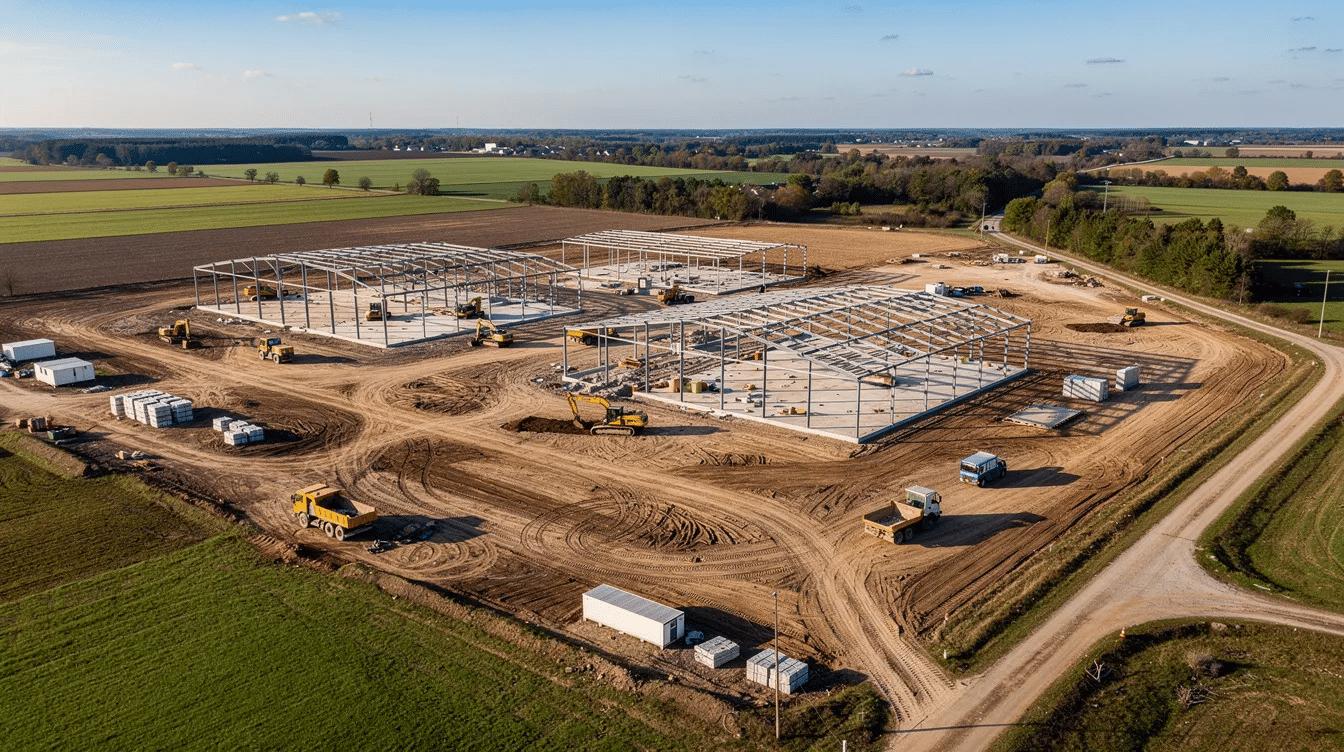
A roughly 250-megawatt AWS data center campus is already under construction in Trenton’s industrial park on approximately 141 acres. The project involves site work, substations, and multiple data halls-substantial work for contractors and the broader supply chain.
A genuine disagreement exists: proponents of Issue 17 argue that once the charter is amended, the facility’s operating capacity would be capped at 25 MW. City officials counter that existing permits and approved development agreements allow the project to proceed as originally planned, citing vested-rights doctrines and constitutional protections against retroactive limitation.
For data center builders and trade contractors, this dispute illustrates why change-in-law clauses and termination provisions matter. Zoning, utility contracts, and vested-rights doctrines can interact unpredictably when new restrictions arrive mid-project. Contractors working long-duration data center construction should verify when approvals were issued and what rights have been established before mobilizing.
Residents’ Concerns: Power, Water, Noise, AI Data Centers, and Utility Bills
Residents have raised serious, good-faith concerns in community meetings and public comment sessions. These deserve fair treatment.
- Grid strain and electricity costs. Citizens worry that a 250 MW campus could stress the local grid, requiring new transmission lines or substation investments. If those infrastructure costs flow through to ratepayers, residents question whether new data center construction can pass the community’s affordability test.
- Water usage. Questions about how many gallons per day cooling systems would consume-and whether potable water or reclaimed sources would be used-are central. Environmental regulations may require stormwater management and water usage assessments before construction approval.
- Noise and air quality. Backup generators at data centers require compliance with air quality regulations and emissions testing. Residents near the site have asked how often generators will run, what fuel types they use, and how the project will manage noise levels in adjacent neighborhoods.
- Traffic and the workforce gap. Nearby residents worry about construction disruption, truck traffic, and road wear. They also ask whether local workers will fill the permanent and construction jobs, or if specialized crews will be brought from outside the county.
None of these concerns are unreasonable. The question is how a community chooses to address them.
ABC Ohio Valley’s Policy Perspective: Objective Standards vs. Blanket Bans
ABC Ohio Valley’s principle is straightforward: communities are right to demand strong protections on power, water, noise, traffic, and ratepayer costs. But those concerns are usually best addressed through clear, enforceable data center zoning standards rather than permanent prohibitions. The association does not tell Trenton residents how to vote on Issue 17. Instead, we advocate for a regulatory approach where builders know the rules in advance and communities can hold owners accountable.
Objective standards let local governments tailor mitigation to site conditions. A blanket ban forfeits tax base, surrenders construction and maintenance work, and sacrifices the opportunity to use modern designs that might actually resolve the issues driving community opposition. Virginia imposed a $0.011/kWh tax on data center electricity from July 1, 2026-generating revenue rather than blocking projects. North Carolina repealed the sales tax exemption for data center electricity effective August 6, 2026, recalibrating incentives. Communities don’t have to choose between tax breaks and protection; effective data center zoning balances operational efficiency and regulatory compliance. Permitting transparency is emphasized nationally to address community concerns regarding data center impacts, and local governments that require transparent permitting processes tend to build more durable support for development.
What Objective Data Center Zoning Usually Covers in Data Center Development
Think of this section as an operational playbook for data center work from a zoning and entitlement perspective.
Power and interconnection. Data centers must meet zoning requirements for power capacity and proximity to the grid. Communities increasingly require load studies, grid-impact analyses, and mitigation plans. New Jersey, for example, requires semiannual water and energy reports from data centers-a model that provides ongoing accountability.
Water sourcing and reuse. Zoning regulations for data centers must address cooling demands and resource consumption. Common rules cap potable water use, mandate onsite storage, and encourage greywater, stormwater reuse, or air-side cooling. Local zoning in some jurisdictions also mandates sustainable and renewable energy sources.
Noise, setbacks, and screening. Zoning laws impose strict noise limits for cooling systems and backup generators near property lines. Decibel limits around residential districts are often set between 50 and 65 dBA. Local ordinances dictate minimum physical setbacks from schools and residential areas. Setbacks and buffers are mandated to minimize visual and noise impacts, and noise from cooling systems and generators often necessitates costly acoustic mitigation measures.
Traffic and road agreements. Haul-route agreements, road-improvement cost sharing, time-of-day limits for heavy truck movements, and communication plans reduce neighborhood pushback during long construction phases.
Ratepayer protections. Host communities can negotiate payments for grid upgrades, require that data center developers-not residential customers-absorb infrastructure costs, and use development agreements to protect local budgets. Zoning codes often limit air emissions from backup systems and require monitoring. Regulatory compliance may include environmental impact assessments before construction approval.
Data centers are often classified under heavy industrial or specialized technology zones. Many municipalities create special zoning districts for data centers to promote clustering and infrastructure efficiency, while Special Use Permits may be required in non-industrial zones, triggering public hearings. Effective zoning integrates infrastructure capacity with sustainable development practices. Zoning regulations often restrict data centers from residential and mixed-use zones entirely. Augusta-Richmond County in Georgia adopted zoning standards for data centers on September 15, 2026, and Tucson established large-scale data center zoning standards effective September 4, 2026-both showing how communities can develop rules rather than bans.

Implications for ABC Ohio Valley Members Across the Region
Trenton’s decision will not directly govern the rest of the Ohio Valley, but it will influence how city councils, county commissions, and townships think about data center zoning. A high-profile vote like Issue 17 can embolden other communities to consider caps, stricter rules, or temporary pauses.
The pattern is already national. Across the country, moratorium pressures are building:
| Location | Action |
|---|---|
| Raleigh, NC | Adopted a six-month moratorium on data center applications |
| Oakland, CA | Implemented a 45-day moratorium on new data center developments |
| Columbus County, NC | Paused data center approvals for 120 days |
| Kennesaw, GA | Approved a six-month moratorium on data centers |
| Savannah, GA | Adopted a 155-day pause on data center conversions |
| Durham County, NC | Imposed a nine-month moratorium on new data centers |
| Gilroy, CA | Paused new data center applications for 45 days to develop standards |
| Cary, NC | Approved an 18-month pause on data center development for zoning studies |
At the state level, California signed seven data center bills on September 21, 2026. Texas paused data center permits until ERCOT completes its audit by October 19, 2026. Arizona will not accept new data center applications until July 1, 2029. Some jurisdictions have adopted moratoriums lasting a year or longer. Others have used an executive order to freeze approvals while they study impacts.
Ohio has roughly 80 operating data centers with about 4,139 MW of capacity and approximately 190 planned data center projects that could add another 25,312 MW. At least 18 Ohio communities besides Trenton have regulatory or ballot measures under consideration. The industry cannot afford to treat these as isolated events.
For members’ business planning, data center projects may face new timing risk, added entitlement steps, and more elaborate community-engagement expectations even in pro-growth jurisdictions with cheap land and available power. The Ohio Valley’s advantages-location, infrastructure access, and support from state and local officials-remain real, but they are not guaranteed. Northern Virginia, long the nation’s densest data center market, has already pushed developers to look elsewhere; Ohio is absorbing much of that demand, which makes local zoning fights here consequential for the entire industry.
Practical Risk Management for Data Center Builders and Trade Contractors
Here is a concise checklist for general contractors, trade partners, and suppliers managing political and zoning risk:
- Track ballot measures early. Monitor local proposal filings, petition drives, and ordinance changes in every jurisdiction where you bid or mobilize. News from a community meeting in July can become a binding charter amendment by November.
- Price permitting risk. Build schedule float and contingency into estimates. Treat political risk the way you treat weather risk or long-lead equipment risk-quantify it and plan for re-sequencing.
- Review change-in-law clauses. Negotiate termination rights, suspension provisions, and cost-adjustment mechanisms in contracts so that sudden zoning changes do not leave contractors bearing disproportionate exposure. These clauses should reference specific regulatory triggers.
- Engage in hearings with facts, not politics. Develop internal protocols for providing testimony on noise, water, power, and design mitigation. Stick to what you know-construction methods, timelines, workforce needs-and avoid partisan advocacy.
Building a Long-Term Operational Playbook for Data Center Work
ABC Ohio Valley members should use the Trenton experience to refine a long-term operational playbook for data center work that integrates technical excellence with community and regulatory awareness.
Invest in upskilling project managers and estimators on zoning, utility coordination, and environmental constraints specific to data centers in states like Ohio, Indiana, Alabama, Georgia, and Florida-anywhere your office pursues this work. Document project benefits clearly: tax revenues, infrastructure investments, new substations, and long-term operations jobs. Collaborate with owners and designers to incorporate quieter equipment, water-efficient cooling, and visually screened yards-design choices that preempt the sources of opposition before a report lands in the local news.
ABC Ohio Valley can support members through advocacy, education on model-ordinance concepts, safety programs, and workforce development that helps close the workforce gap and keeps data center projects attractive to both investors and communities. Understanding the status of Ohio data center regulations and local charter powers is becoming as important as understanding structural steel or medium-voltage systems. The future of this work depends on it.
FAQ
Does Issue 17 affect data center projects outside Trenton’s city limits?
No. Issue 17 amends only Trenton’s city charter and applies within city boundaries. Neighboring townships and counties maintain their own zoning powers and could still host large facilities if their ordinances and permits allow. A project denied in the city could potentially proceed in a nearby location under different land-use rules, though it would be subject to that jurisdiction’s own analysis and approval process.
Could other Ohio Valley communities copy Trenton’s 25-megawatt cap?
Each city or township has its own legal framework, but a visible charter amendment like Issue 17 can serve as a political model. Local leaders or citizens in Ohio, Indiana, or elsewhere may reference Trenton when drafting their own proposals. The exact thresholds, legal mechanisms, and pay structures for developer obligations may differ, but the precedent is now established, and the processing of similar petitions will follow the constitutional standard the Ohio Supreme Court reaffirmed.
How should contractors price the risk of new ballot measures or data center moratoriums?
Treat political and zoning risk similarly to weather or long-lead equipment risk. Build schedule float, allow for re-sequencing of work, and discuss contingency structures with owners tied to defined regulatory triggers. Include cost escalation provisions and determine in advance who bears delay costs if a vote or moratorium pauses construction.
What role can ABC Ohio Valley play when a community considers a data center ban?
ABC Ohio Valley can provide neutral technical information on construction impacts, advocate for objective standards over blanket bans, and coordinate member testimony-all while respecting local self-governance. The association does not endorse specific ballot outcomes but works to ensure that laws governing data center development are grounded in measurable, enforceable criteria.
Are data center bans the only response to resident concerns about utility bills?
No. Communities can also use special tariffs, infrastructure cost-sharing agreements, and stipulations in development deals so that data center owners-not residential customers-shoulder defined portions of grid and water-system upgrades. These tools reduce the pressure for outright bans while giving the community enforceable protections and ongoing access to revenue from approved facilities.