

From AI Hype to Measurable ROI on Real Jobs
AI in construction is moving from conference-stage buzz to practical testing inside estimating, document control, scheduling, and other workflow-heavy parts of the business. Construction Executive recently framed the shift clearly: for midsized contractors, the real issue isn’t whether AI sounds promising, but where it can deliver measurable return first.
For commercial and industrial contractors in Cincinnati, Dayton, Springfield, Lima, Northern Kentucky, and Southeastern Indiana, that question is especially practical. Margins are won or lost in repeatable office and field processes, not in broad technology promises. The firms that get value from AI are usually the ones that start with one workflow, define success in advance, and test the tool without disrupting the rest of the company.
This article is a decision guide for choosing where to start. It covers which workflows are often the best first candidates, how to set up a low-risk pilot, what to measure, and how ABC Ohio Valley members can connect that effort to peer learning and leadership development through Next Gen Leaders and other chapter resources.
What Practical AI in Construction Means for Midsized Contractors
For most midsized contractors, practical AI in construction does not mean autonomous job sites or replacing experienced people with software. It usually means AI features embedded in the systems a company already uses for estimating, project management, accounting, scheduling, or document handling.
Three broad categories matter most:
- Workflow automation. Tools that sort, route, classify, or summarize repetitive digital work such as submittals, pay applications, meeting notes, or approval chains.
- Prediction and forecasting. Tools that analyze historical and current project information to highlight likely schedule pressure, cost variance, or process bottlenecks earlier than a manual review might.
- Generative assistance. Tools that help draft first-pass summaries, responses, checklists, or internal documentation so teams spend less time starting from a blank page.
That matters because the best early use cases usually support the judgment of estimators, project managers, controllers, and field leaders rather than trying to replace it. For merit shop contractors, that fits a simple principle: technology should help strong people perform at a higher level.

Where AI Usually Pays Back First
The safest place to begin is not everywhere at once. It is one workflow with four characteristics: it is repetitive, mostly digital, time-consuming, and easy to measure before and after a pilot. For many contractors, four areas rise to the top.
- Estimating and takeoff support. This is often the most practical first use case because the inputs are repeatable, teams already track effort informally or formally, and leadership can evaluate whether a tool helps the estimating team work faster or more consistently.
- Document and contract administration. AI can help organize, classify, route, and summarize document-heavy processes that otherwise consume project management, accounting, and compliance time.
- Project controls and schedule-risk review. Some tools help teams spot likely delay points or coordination problems sooner by surfacing patterns inside project data.
- Progress tracking and visual review. On some projects, image-based tools can support progress documentation and comparison against plans or expected sequences, though this is often a later-stage pilot for midsized firms.
These are not the only possible applications, but they are usually easier to evaluate than broader promises around enterprise transformation. ABC Ohio Valley has already noted that contractors are using AI for predictive scheduling, cost and risk forecasting, safety monitoring, equipment maintenance, and document automation. Just as important, the chapter’s AI guidance emphasizes an incremental approach: start with one high-value use case, prove ROI in months rather than years, then scale carefully.
Why Estimating Is Often the Best First Pilot
Estimating is a natural starting point because it combines repeatable inputs with clear business value. Bid teams work against constant time pressure. Even modest gains in speed, consistency, or review quality can matter if they help a company pursue better-fit work or reduce rushed last-minute effort.
In practice, AI-assisted estimating tools may help teams review drawing sets, organize takeoff inputs, compare scope across documents, or speed up first-pass quantity work before a human estimator validates the result. That does not remove the need for experience. It changes where experienced people spend their time.
For an Ohio Valley contractor, a disciplined estimating pilot might look like this: choose one trade, one estimator or small estimating group, and a limited set of upcoming bids with similar scope. Compare the pilot against the company’s normal process on time spent, review effort, consistency, and downstream corrections. If the tool helps the team turn around pricing faster without weakening confidence in the estimate, leadership has a real basis for deciding whether broader rollout is justified.
This kind of approach also connects well to broader growth discipline. If estimating gains free up capacity, leadership can decide whether that time should go toward more bids, better qualification, deeper scope review, or stronger handoff to operations. That is where AI in construction starts affecting backlog quality instead of becoming just another software subscription.
Document Automation May Be the Fastest Relief Point for Some Firms
For other contractors, the first clear payoff may come from document-heavy workflows rather than estimating. Mid-market firms often manage large volumes of pay applications, change orders, insurance certificates, submittals, meeting notes, and compliance records. The cost isn’t just labor time. It is also delays, inconsistency, and missed follow-up.
AI-supported document workflows can help teams classify files, extract key details, route items for review, and summarize large amounts of text for faster decision-making. For project accountants, controllers, and project managers, that can mean a cleaner path from inbox to action.
The most useful question is not whether the software sounds advanced. It is whether the process being targeted already has enough structure to improve. If every PM handles change orders differently and stores documents inconsistently, the AI layer may struggle. If the workflow is already fairly disciplined but still too manual, AI may help the team move faster with fewer touches.
A contractor in Lima or Dayton, for example, might pilot an AI-enabled change-order workflow on one recurring project type and measure how long it takes to move from identification to pricing to approval compared with the current process. That is a stronger ROI test than adopting a broad platform and hoping the value appears later.
How AI Can Support Project Controls Without Rebuilding the Whole Scheduling Process
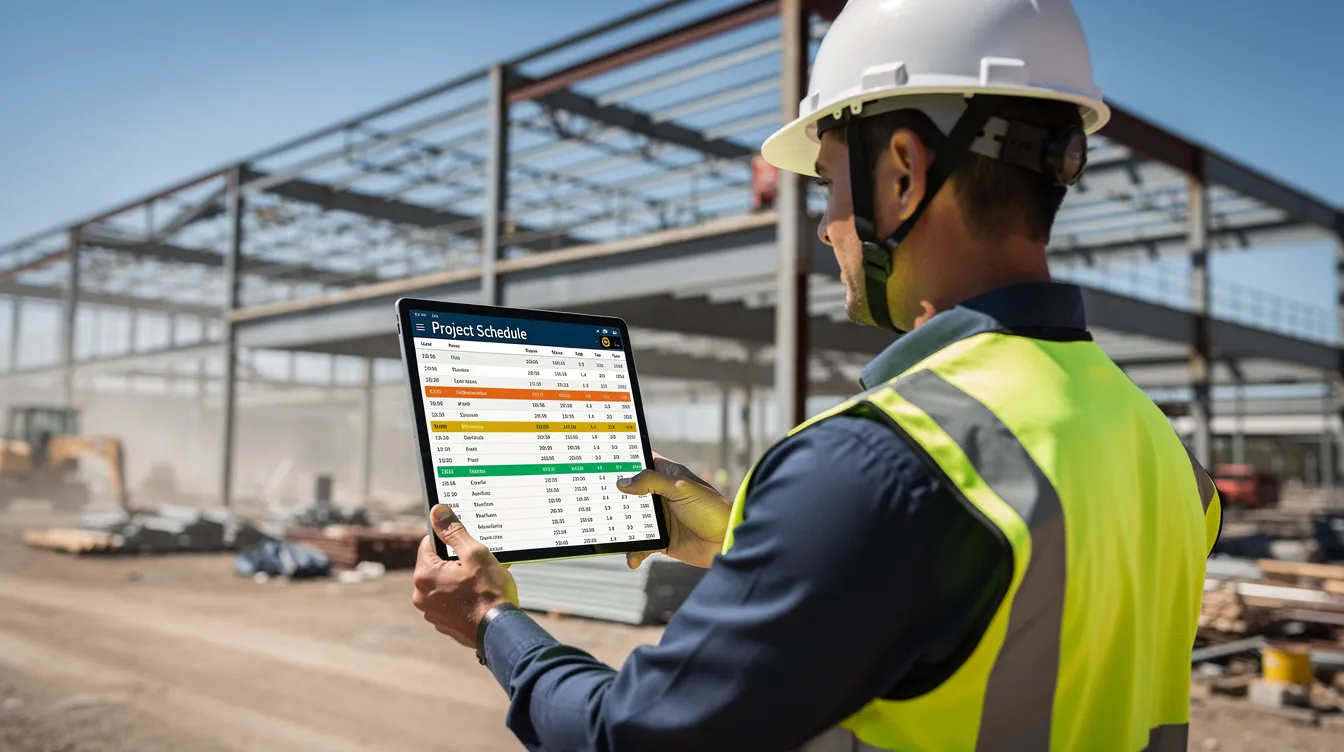
Project controls is another promising area, but it works best when expectations are realistic. For most midsized contractors, AI will not replace the need for solid schedules, reliable updates, or experienced field leadership. It may help teams identify pressure points earlier.
Used well, AI support in project controls can help review current schedules, compare current conditions to historical patterns, and surface activities or sequences that deserve earlier attention. That can be useful on corridor work, industrial shutdowns, healthcare renovations, and other projects where coordination problems tend to multiply once they are visible to everyone.
| Review Element | Traditional Weekly Review | AI-Supported Review |
|---|---|---|
| Risk visibility | Depends heavily on manual reporting and memory | Can highlight patterns, exceptions, or items needing review sooner |
| Schedule pressure | Often discussed after a problem becomes obvious | May surface probable trouble spots earlier |
| Meeting preparation | Requires manual collection of updates | Can speed summaries and focus discussion on exceptions |
| Decision speed | More reactive | Potentially more preventive |
For Ohio Valley contractors working along the I-75 and I-70 corridors, where schedule coordination often drives profitability, the value of a pilot here is simple: can the tool help PMs and superintendents act earlier, not just report faster?
What Has to Be True Before a Pilot Starts
AI adoption usually succeeds or fails on process readiness, not on marketing language. Before launching a pilot, contractors should pressure-test a few basics:
- Consistent data structure. Are cost codes, document names, and project records organized consistently enough for a tool to work with them?
- Defined workflow ownership. Is it clear who owns estimating review, document approvals, or project-controls updates?
- Centralized information. Are drawings, specs, logs, and related files stored where the team can actually use them?
- Existing process discipline. Is there already a repeatable workflow to improve, or is the company hoping software will create one from scratch?
That last point matters most. AI is usually better at accelerating a defined process than fixing a broken one.
Integration also matters. A tool that connects to existing systems is usually easier to test and evaluate than one that requires teams to maintain a separate parallel process. And like any operational change, adoption depends on people. Short training sessions, a clearly named pilot owner, and early user feedback matter more than a flashy demo.
A Simple Framework for Choosing the First AI Pilot
ABC Ohio Valley’s own AI adoption guidance favors starting small, proving value, and scaling carefully. For contractors trying to turn that principle into action, the following framework keeps the decision practical.
- Choose one painful workflow. Pick a process that already creates delay, overtime, rework, or avoidable administrative drag.
- Limit the scope. Use one team, one project type, one office function, or one recurring customer segment so comparisons stay meaningful.
- Name one accountable owner. Someone has to own setup, user feedback, metrics, and the go/no-go recommendation at the end.
- Use one tool at a time. Testing several overlapping products at once makes it harder to judge what is working.
- Set the evaluation window in advance. A defined pilot period creates discipline and forces a decision based on evidence rather than excitement.
For many firms, this process can be organized within a quarter. The exact duration matters less than the discipline: define the baseline first, test one use case, and decide what to do next using actual results.
How to Measure ROI Without Guessing
Don’t expand AI in construction because it feels modern. Expand it because it improves a measurable part of the business.
For estimating pilots, useful measures may include:
- Time spent per takeoff or estimate
- Number of bids completed with the same staff capacity
- Internal revisions or downstream corrections
- Confidence of estimators and reviewers in the final output
For document workflows, useful measures may include:
- Cycle time from receipt to action
- Manual handoffs per document
- Missing follow-ups or expired items
- Time spent by PMs, accountants, or coordinators on routine processing
For project-controls pilots, useful measures may include:
- How quickly risks are identified and discussed
- How often schedule problems are surfaced before they become field emergencies
- Time spent assembling weekly updates or exception reports
The important part is not building a perfect dashboard. It is capturing a usable before-and-after comparison so leadership can decide whether the pilot improved speed, consistency, decision quality, or all three.
Common Mistakes That Turn AI Into Overhead
Most failed pilots do not fail because AI has no value. They fail because the rollout is too broad, the workflow is unclear, or they never defined success.
Starting with the demo instead of the problem. A feature-rich tool is not a business case. Begin with the operational pain point.
Skipping data cleanup. Inconsistent file names, scattered records, and uneven cost coding make even good tools look ineffective.
Ignoring the people doing the work. If estimators, PMs, project accountants, or field leaders are not involved early, adoption often stalls.
Expecting general-purpose AI to handle construction-specific risk. Public chatbot tools may help with drafting or brainstorming, but they are not a substitute for disciplined workflows, job-cost structure, or construction-specific controls.
Trying to scale before proving value. One successful workflow is a stronger foundation than a companywide rollout with vague expectations.
What Ohio Valley Contractors Should Do Next
The practical case for AI in construction is not about chasing every new tool. It is about finding one part of the business where better speed, visibility, or consistency can be measured and then deciding, with discipline, whether that gain is worth scaling.
For Ohio Valley merit shop contractors, the next step is straightforward: identify one workflow in estimating, document control, or project controls that creates obvious friction right now. Define how your team handles it today. Then design a limited pilot with one owner, one tool, and clear before-and-after measures.
ABC Ohio Valley members do not have to work through those questions in isolation. The chapter’s technology and leadership resources, including its broader construction news and member education efforts, can help firms compare notes with peers, build internal buy-in, and connect new tools to stronger management practice rather than isolated experimentation.
If your company is ready to turn AI from a talking point into an operating test, start small, measure honestly, and scale only what improves the way your team actually builds work.